What Is Box Breathing and How Can It Calm Anxiety in 3 Minutes?

There are moments when anxiety does not arrive as a clear thought. It arrives as a tight chest, a clenched jaw, fast breathing, a restless stomach, or the feeling that your body has started bracing before your mind has even named what is wrong.
That is where a practice like box breathing can help. It is not complicated. It does not require equipment. It does not ask you to clear your mind or force yourself into calm. It simply gives your breath a rhythm to follow, and that rhythm can give your nervous system something steady to respond to.
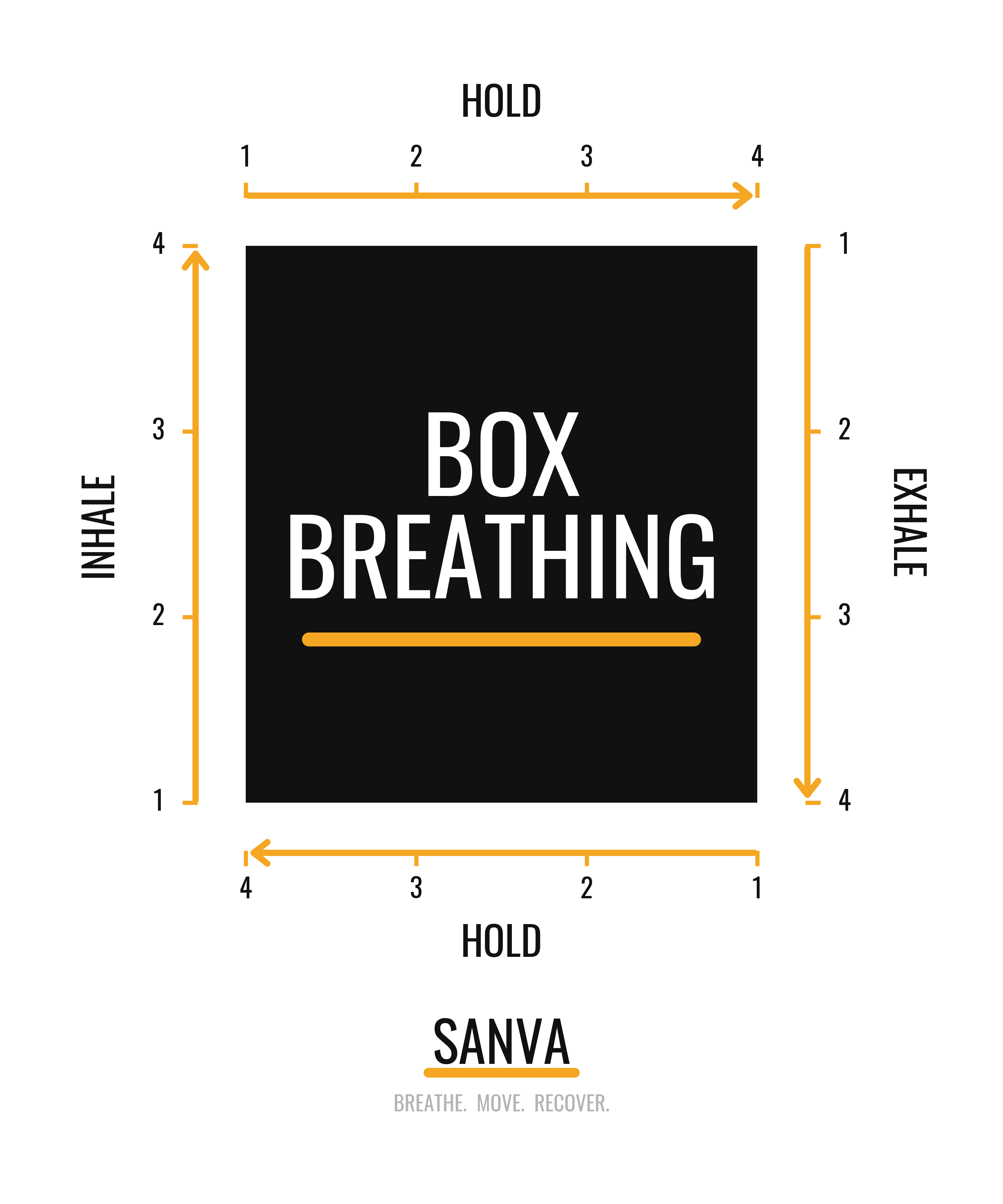
Box breathing is usually taught as a four-part pattern: inhale, hold, exhale, hold. Each part is counted evenly, most often to four. You breathe in for four counts, pause for four counts, breathe out for four counts, and pause again for four counts before beginning the next cycle.
Box breathing is a structured breathing practice that uses equal counts for inhaling, holding, exhaling, and holding again. The most common version is 4-4-4-4 breathing.
The reason it can feel calming is not mysterious. Breathing is one of the few body processes that happens automatically but can also be influenced on purpose. When anxiety speeds the body up, breathing often becomes quicker, higher in the chest, and less steady. When you slow the breath down and give it structure, you send the body a different signal.
Why breathing changes how anxiety feels
Anxiety is not only a mental experience. It is also a physical state. When the brain senses threat, uncertainty, pressure, or overwhelm, the body can move toward a fight-or-flight response. Heart rate may rise. Muscles may tense. Attention narrows. Breathing may become shallow or rapid.
That reaction is useful if you are in immediate danger. It is less useful when the “danger” is an inbox, a difficult conversation, a busy train, a deadline, or a thought loop at 2 a.m.Slow, steady breathing can support the opposite direction: a shift toward the parasympathetic nervous system, often called the body’s rest-and-digest mode.
How box breathing works
The classic pattern is simple enough to remember without an app or a script.
Part of the cycle | What to do |
Inhale | Breathe in gently for four counts. |
Hold | Pause softly for four counts. |
Exhale | Breathe out slowly for four counts. |
Hold | Pause again for four counts before repeating. |
A full cycle takes about 16 seconds. If you practise for around three minutes, you will complete roughly 10 to 12 cycles. That is often enough time to notice some kind of shift. Your breathing may feel steadier. Your shoulders may lower. Your attention may stop bouncing around quite so much.
The breath should stay comfortable. This is important. Box breathing is not about taking the biggest breath possible or proving you can hold your breath. Many people find it more calming when the breath is quiet, modest, and relaxed. If the holds make you tense, shorten them. If four counts feels too long, use three. The technique should meet your body where it is, not become one more thing to perform.
A 3-minute way to try it
Choose a position that feels easy. You can sit, stand, or lie down. If closing your eyes makes you feel more unsettled, keep them open and rest your gaze on one point in the room.
Start by exhaling naturally, as if you are letting the day leave your body by a few degrees. Then inhale through the nose for four slow counts. Pause gently for four. Exhale through the nose or mouth for four. Pause again for four. Repeat that pattern for three minutes.
Your mind will probably wander. That is not a problem. Wandering thoughts are not proof that you are doing it wrong. The count is simply there to bring you back: inhale, hold, exhale, hold. Again and again.
If you feel dizzy, panicky, short of breath, or uncomfortable, stop and return to normal breathing. If holding the breath increases anxiety, remove the holds and try a softer pattern instead, such as inhaling for four and exhaling for six. The goal is not to complete a perfect square. The goal is to help your body feel safer.
When box breathing is most useful
Box breathing tends to work best when anxiety is present but not completely overwhelming. Think of it as a reset button, not a cure-all. It can be useful before a stressful meeting, after an argument, during a work break, before sleep, or before a performance where nerves are high but you still want to feel focused.
It is also worth practising when you are not anxious. That may sound strange, but it matters. Skills are easier to access under stress when the body already knows them. If you only try breathing exercises at the peak of panic, they may feel unfamiliar or frustrating. A few calm repetitions each day can make the rhythm easier to return to when you actually need it.
Why the counting helps
The counting is not just decoration. It gives attention a job. When anxiety is high, the mind often jumps between “what if” scenarios. Counting the breath does not solve every problem, but it can interrupt the loop. Instead of trying to argue with every anxious thought, you shift attention toward something concrete and physical.
That is one reason box breathing can feel more approachable than open-ended meditation. You are not being asked to sit in silence and hope your mind behaves. You are given a structure. For many people, that structure makes the practice easier to trust.
Common mistakes to avoid
The most common mistake is trying too hard. People take huge breaths, force the holds, count too quickly, or expect an instant wave of calm every time. That usually makes the practice less effective, not more.
A better approach is to make the breath smaller and slower. Let the inhale be gentle. Let the pauses be soft. Keep the shoulders, jaw, and throat as relaxed as you can. If the classic 4-4-4-4 rhythm feels rigid, adapt it. Your nervous system responds better to safety than to discipline.
It also helps not to wait until anxiety is at its loudest. Box breathing can be used during mild stress, before a difficult moment, or after your body has been activated. In those moments, the practice has more room to work.
When to get extra support
Breathing practices can be powerful, but they have limits. If anxiety is frequent, severe, interfering with daily life, causing panic attacks, affecting sleep, or making you avoid important parts of life, it may be time to speak with a qualified health professional.
Breathwork can sit alongside therapy, medical support, lifestyle changes, movement, community, and recovery practices. It does not need to carry the whole load.
A simple way to start today
Try box breathing once today when you are not in crisis. Set a timer for three minutes. Sit comfortably. Breathe in for four, hold for four, breathe out for four, hold for four. Repeat gently.
Afterwards, ask yourself one question: Do I feel even 5% steadier?That small shift matters. Many wellbeing practices are built on small shifts repeated consistently. Calm is rarely something we force. More often, it is something we practise returning to.
Want to go deeper?
If this helped, Sanva is being built for exactly this kind of everyday support. At sanva.app, you will find more than quick tips: guided breathing practices, recovery sessions, meditation, multi-day challenges, full courses, and a community designed to help you build calmer routines over time.
Box breathing can be a first step. Sanva is where you can keep going.